tree health
Tree Care

 Whether you’re a landscape manager, city or urban forester, or even a homeowner, healthy trees matter, not only for aesthetics, but also for budget. Trees prone to disease, especially those that can spread quickly through a canopy, are a threat to long-term investment, and removal and replacement can be costly.
Scoping out tree problems and diseases is, therefore, essential. Sometimes those problems are obvious. Other times, it’s just a feeling that something doesn’t look quite right. Learning what to watch for and recognizing the early signs of tree diseases, such as Pseudomonas, can make all the difference. Early identification helps limit the spread, protect surrounding trees, and prevent small issues from becoming long-term canopy problems.
Quick Links:
Pseudomonas is a type of bacterium that causes disease in trees, most commonly in stone fruit and ornamental trees. It’s known to cause bacterial canker, a condition that damages nearly every part of a tree, including bark, buds, leaves, and young shoots.
It’s spread through natural openings, pruning cuts, frost cracks, and other tree wounds, with infection occurring primarily during cool, wet conditions; think late fall, winter, and early spring when trees are dormant or just breaking bud. It’s just one reason you should make sure you’re cleaning pruning tools!
While pruning tools can spread pseudomonas, some trees are more at risk than others. More specifically, trees already under stress, including newly planted trees, drought-plagued trees, trees with freeze injury, or those struggling due to poor site conditions, are far more susceptible to the bacteria.
Once established, the bacteria disrupt normal tissue function, leading to sunken cankers, dieback, oozing sap, and weakened branch structure.
When managing a landscape or urban forest, monitoring tree health is essential. Small changes detected early can prevent much bigger problems, and, like many tree diseases, pseudomonas doesn’t always announce itself right away.
Symptoms often develop gradually and are often mistaken for winter tree injuries or general stress, especially early on. Knowing what to look for and when can help you catch issues before significant damage occurs.
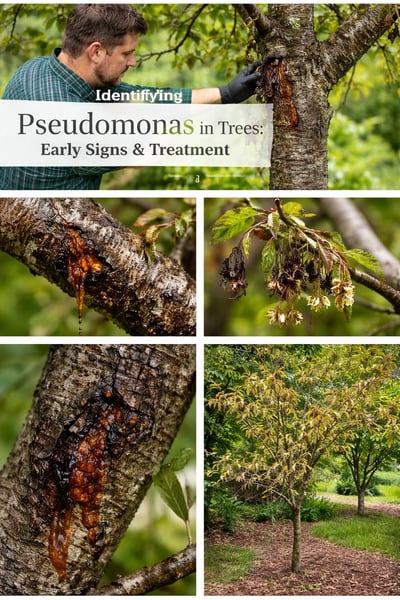 Common Pseudomonas symptoms
Symptoms often become most noticeable in late winter through early spring, when fluctuating temperatures and moisture create the perfect conditions for bacterial activity. In many cases, damage appears near pruning wounds, frost cracks, or previous injury sites, where the bacteria have gained entry.
Because Pseudomonas is a bacterial tree disease, symptoms can progress quickly under the right conditions. Early recognition allows for better tree pruning decisions, reduced spread, and more effective tree disease prevention strategies.
Tree cankers can look similar on the surface, but bacterial cankers caused by Pseudomonas and fungal cankers behave very differently. Misidentifying bacterial canker as a fungal issue can lead to ineffective treatments and increased tree stress.
Understanding the differences is critical for making the right management and prevention decisions.
Correct identification of Pseudomonas and fungal cankers is essential in mitigating the problem and stopping the spread of tree disease.
Unlike fungal diseases, bacterial diseases have different needs. Because Pseudomonas is a bacterial tree disease, there is no reliable curative treatment once infection is established.
Treating it, therefore, is less about eliminating the bacteria and more about managing conditions that allow the disease to spread. Successful management focuses on limiting damage, reducing spread, and supporting overall tree health.
Trees under stress are far more vulnerable to Pseudomonas. Supporting tree health can slow disease progression:
In some commercial or nursery settings, preventative copper-based fungicide may be used during dormancy or before bud break. These products are preventative, not curative, and must be carefully timed to avoid plant injury. Their use should always follow label directions and local extension guidance.
Again, prevention and mitigation are the best strategies.
Unfortunately, in cases of severe infection, especially on young, newly planted, or structurally compromised trees, tree removal may be required to prevent spread to nearby healthy trees.
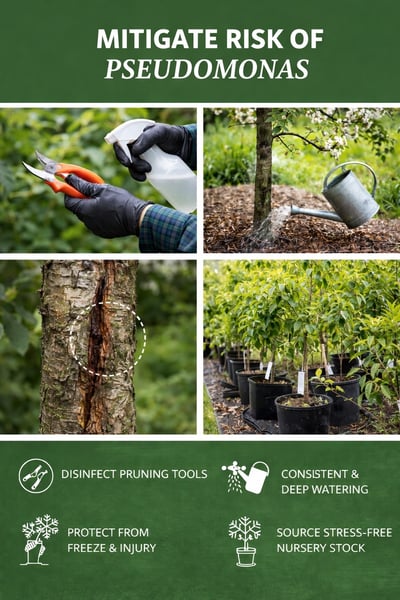 How to Mitigate Risk of Pseudomonas
Mitigating the risk of Pseudomonas starts long before symptoms appear. We cannot overstate the effectiveness of prevention and mitigation over attempting treatment after the infection has taken hold. The goal is to limit entry points, reduce stress, and create conditions that support resilient tree health.
Proper species selection is one of the most effective tools for disease prevention. Some trees are naturally more susceptible to bacterial cankers, especially in climates with frequent freeze–thaw cycles or prolonged spring moisture. Selecting native species and cultivars that are well adapted to local conditions reduces stress and lowers infection risk.
Where a tree is planted plays a major role in disease resistance:
Trees planted in unsuitable sites are more likely to experience stress, making them vulnerable to Pseudomonas and other tree diseases.
Pruning wounds are one of the primary entry points for Pseudomonas bacteria.
Careful timing of pruning significantly reduces the risk of infection.
Healthy trees are better able to withstand damage and resist infection:
For trees with a history of bacterial canker or those growing in high-risk environments, preventative strategies such as dormancy-period monitoring, cautious pruning, and proactive stress reduction can help limit recurrence. A comprehensive tree inventory can be invaluable for monitoring and tracking issues, helping you stay proactive.
Whether it’s streetscapes, tree-lined walkways, or city parks, in urban forests and community landscapes, trees often grow close together. Urban stressors like compacted soils, pruning wounds, freeze–thaw cycles, and moisture fluctuations make Pseudomonas especially concerning. Because it spreads easily through wounds, shared tools, wind-driven moisture, and closely spaced plantings, monitoring in urban forests is essential.
The symptoms often appear after infection has already occurred, and Pseudomonas can move quietly through neighborhoods, parks, and managed landscapes before it’s even recognized. Once established, it weakens the branch structure, increases the risk of failure, and can affect overall canopy health if not managed early.
Preventing bacterial tree diseases, such as those caused by Pseudomonas, starts before symptoms appear. It begins with healthy nursery stock, thoughtful species selection, proper planting, and informed long-term care.
That’s why working with a trusted wholesale nursery, like SuperTrees, matters. Healthy trees start with healthy roots, and the right nursery partner can deliver not only high-quality trees but also provide expert guidance and ongoing support.
From seed to service, we’re working to help urban forests and managed landscapes thrive for decades to come. We can help with tree and site selection, and our air pot technology helps trees establish quickly, meaning they’re stronger and better able to fight tree disease. Reach out to our team today and let’s get planting!